Call



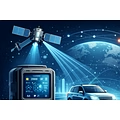
GPS tracking technology is entering a new futuristic era, transforming from basic location-reporting hardware into intelligent, autonomous, AI-driven global positioning systems. Modern GPS tracking devices now integrate multi-constellation satellite navigation, artificial intelligence, IoT connectivity, cybersecurity frameworks, and cloud-based analytics, enabling ultra-precise, real-time, and predictive tracking on a global scale.
This in-depth blog is written for technical knowledge and future-readiness, covering the latest and upcoming GPS tracking device technologies worldwide relevant to GPS tracking, IoT, fleet management, autonomous systems, and smart infrastructure.
Traditional GPS trackers relied solely on single-frequency satellite signals. Futuristic tracking systems now operate as location intelligence platforms, combining:
Multi-band GNSS positioning
AI-powered sensor fusion
Edge computing
Satellite + cellular hybrid communication
Predictive analytics
This evolution enables tracking systems to deliver context, behavior analysis, and decision intelligence, not just coordinates.
Modern advanced GPS tracking devices support:
GPS
GLONASS
Galileo
BeiDou
QZSS
Using L1, L2, and L5 frequency bands, these devices achieve:
Centimeter-level accuracy
Faster time-to-first-fix (TTFF)
Higher resistance to signal interference
multi-constellation GNSS, high-precision GPS, global navigation satellite system
Futuristic GPS trackers implement:
RTK (Real-Time Kinematic) corrections
PPP (Precise Point Positioning) services
These technologies deliver sub-decimeter accuracy, essential for:
Autonomous vehicles
Drones
Precision agriculture
Robotics
RTK GPS tracking, high accuracy positioning system
Advanced GPS tracking devices integrate multiple sensors:
Accelerometer
Gyroscope
Magnetometer
Barometer
Temperature and motion sensors
Using AI algorithms and Kalman filtering, these devices:
Eliminate GPS drift
Enable dead reckoning
Predict movement patterns
Detect anomalies and misuse
AI GPS tracking, sensor fusion technology, intelligent tracking systems
Futuristic GPS trackers support:
4G LTE
LTE-M
NB-IoT
5G
These technologies enable:
Low-latency data transmission
Global roaming
Power-efficient tracking
For remote and cross-border operations, advanced GPS tracking devices use:
Low Earth Orbit (LEO) satellite networks
Hybrid satellite-cellular switching
This ensures uninterrupted global tracking across oceans, deserts, and remote regions.
satellite GPS tracking, global asset tracking system
Modern GPS tracking platforms are cloud-native, leveraging:
Real-time data streaming
Big data processing
AI-driven dashboards
Predictive analytics
Capabilities include:
Fleet optimization
Predictive maintenance
Route intelligence
Digital twin creation
GPS tracking software, cloud-based tracking platform
Futuristic GPS tracking devices incorporate zero-trust security models:
Secure boot
Hardware root of trust
End-to-end encryption
OTA firmware authentication
Compliance with global data protection standards ensures secure and privacy-first tracking systems.
Secure GPS tracker, encrypted tracking devices
Advanced GPS tracking devices power:
AI-based fleet tracking
Driver behavior analysis
Fuel optimization
Predictive vehicle diagnostics
Self-driving systems rely on:
Ultra-high precision GPS
V2X communication
Microsecond time synchronization
Modern tracking enables:
Real-time shipment visibility
Cold chain monitoring
Global container tracking
GPS tracking integrates with:
Traffic management systems
Public transport monitoring
Emergency response coordination
Futuristic wearable GPS trackers support:
Health monitoring
Fall detection
Child and elderly safety
Next-generation GPS tracking devices use:
Ultra-low power chipsets
AI-based sleep cycles
Solar and kinetic energy harvesting
Battery life can extend from several years to near-perpetual operation in asset tracking use cases.
Long battery GPS tracker, low power tracking device
The future of GPS tracking includes:
Quantum positioning systems
AI-native GNSS chips
6G-enabled location services
Swarm-based asset tracking
Space-based GNSS augmentation
GPS tracking will evolve into autonomous, self-learning location intelligence ecosystems.
SPLAKDHN Futuristic advanced GPS tracking devices represent a convergence of satellite navigation, artificial intelligence, IoT connectivity, cybersecurity, and cloud computing. These systems are shaping the future of transportation, logistics, automation, smart cities, and global infrastructure.
The next generation of GPS tracking is no longer about knowing where something is, but understanding how it behaves, predicting what will happen next, and enabling intelligent decisions globally.